
Understanding Different Tax Filing Options: Which One Is Right for You?
Choosing the right tax filing option can have a significant impact on your financial situation and ensure compliance with the law. We will explore the various filing options available so you can make an informed decision about which one is right for you. Get financial help from Lighthouse Financial!

Single
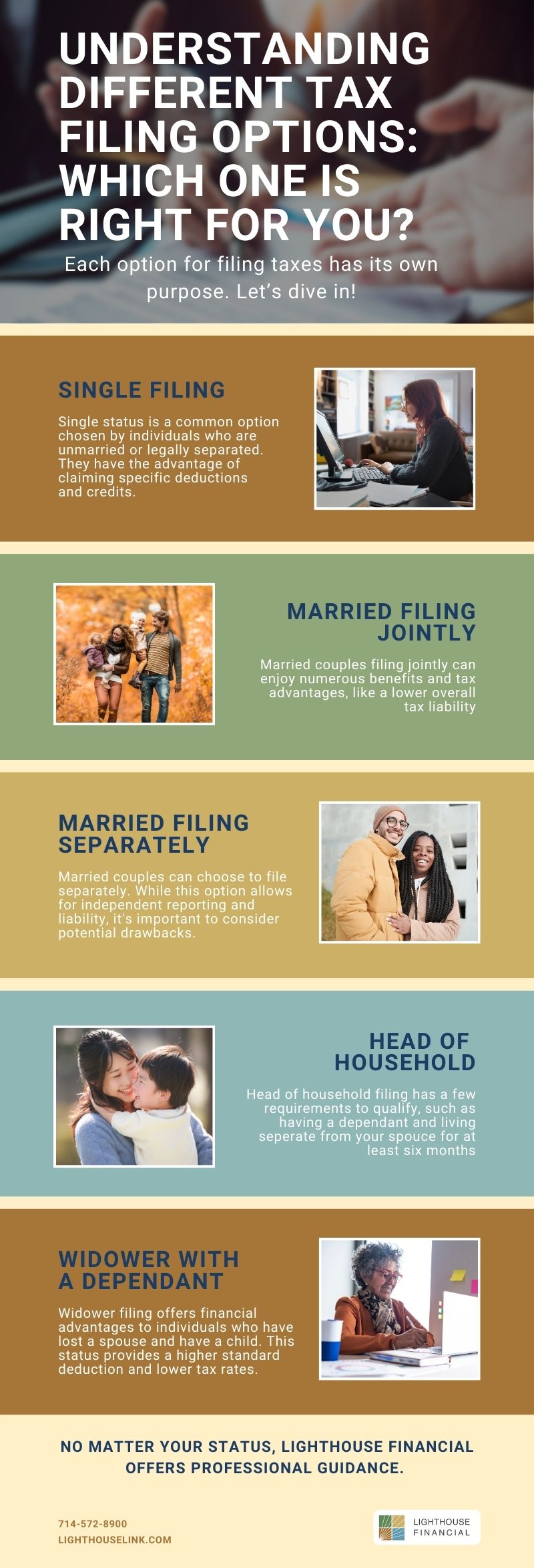
The “Single” status is a common option chosen by individuals who are unmarried or legally separated. As a single taxpayer, you have the advantage of claiming specific deductions and credits not available to other filing statuses. These include the standard deduction, which reduces taxable income, and the ability to itemize deductions for expenses like mortgage interest, medical expenses, and charitable contributions.

Married Filing Jointly
Married couples who choose to file jointly can enjoy numerous benefits and tax advantages. By combining your incomes, deductions, and credits on one tax return, you often experience a lower overall tax liability than if you were to file separately. Additionally, filing jointly opens the door to potential tax credits and deductions, including the Earned Income Tax Credit and the Child and Dependent Care Credit.

Married Filing Separately
Married couples can choose to file separately under the “Married Filing Separately” status. While this option allows for independent reporting and liability, it’s important to consider potential drawbacks. Filing separately may result in a higher overall tax burden compared to filing jointly, as income and deductions are reported individually.

Head of Household
To qualify as head of household, you must be unmarried, provide more than half the cost of maintaining a home for yourself and a qualifying dependent, and have lived apart from your spouse for at least the last six months of the tax year. Filing as head of household offers a higher standard deduction and potentially lower tax rates compared to filing as a single or married filing separately.

Qualifying Widower With a Dependent
This filing status offers financial advantages to individuals who have lost a spouse and have a dependent child. This status allows for joint tax returns for two years after the spouse’s death, providing a higher standard deduction and potentially lower tax rates.
Looking for professional financial support for the upcoming tax season? Contact us now to discuss your tax needs and ensure you’re on the right path!
Related Articles

Strong Earnings, Weaker Stocks: Why Hyperscaler Results Aren’t Pleasing the Market

Is AI Out Over Its Skis?

The Private Credit Mirage and Unfolding Market Stress

Resilient Data vs. Geopolitical Noise
Get In Touch
Contact our team of professionals today.
ADDRESS
3070 Saturn Street, Suite 101. Brea, CA 92821